A huge hole opened in Antarctic sea ice in midwinter, something satellites had never seen there since 1979
It was almost the size of Portugal and lasted a few days. Six atmospheric rivers of mild air and warmer water rising from the depths kept the sea from freezing.
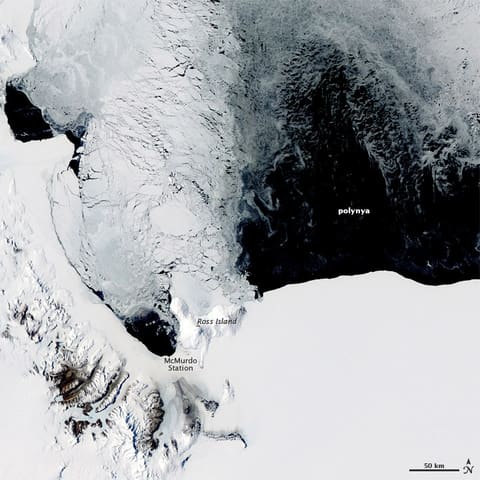
In the middle of the Antarctic winter, when the sea should be almost entirely frozen, a huge patch of open water opened in the ice of Breid Bay, in East Antarctica. It happened in August 2024, and a study published in Geophysical Research Letters now explains why.
A hole that shouldn’t be there
These clearings of open sea surrounded by ice are called polynyas. Far from the coast they are rare, and they almost always appear in the Weddell Sea. In this area, in July and August, about 93% of the sea is normally covered by ice.
According to the study, satellites had not seen anything like it there in winter since 1979, when records began.
| Date (2024) | What happened |
|---|---|
| 4 August | Three clearings appear in the ice |
| 8 August | The hole reaches its maximum size |
| 10 August | It shrinks to about 8,700 km² |
| Mid-August | The sea freezes over again |
Figures for the maximum size differ: the published information mentions about 77,000 km² on 7 August and 89,121 km² at its greatest extent, almost as large as Portugal.
Heat from above and below
- From the air: between 6 July and 6 August, six atmospheric rivers arrived, streams of mild, moist air. The strongest brought air about 17 °C warmer than normal. Snow and clouds also insulated and warmed the ice.
- From the sea: strong winds lifted warmer water from the depths, and a marine heatwave kept the surface up to 0.6 °C above normal.
Ice cover fell from 96% in early July to less than 25% by the end of the month.
What isn’t known
The work, led by Jeebanjyoti Swain of India’s National Centre for Polar and Ocean Research, looks only at the 2024 winter. The authors don’t estimate how often it could happen again.
Sea ice is key for Antarctic wildlife, as shown by how emperor penguins are studied in the depths of winter.
Sources and references
- Geophysical Research Letters – study of the Breid Bay polynya (27/09/2026)
- ECOnews (ECOticias) – A hole almost as big as Portugal opened in Antarctic sea ice (06/11/2026)
This is original editorial content based on the sources cited. Spotted a mistake? Let us know and we will fix it under our corrections policy.