Only 58 adult long-spined sea urchins left across the Canary Islands, the lowest count since 1965
Some seabeds once held more than 14 urchins per square metre; now they turned up in only 17 of 76 surveys, with no juveniles. Without this grazer, algae are covering the rocks again.
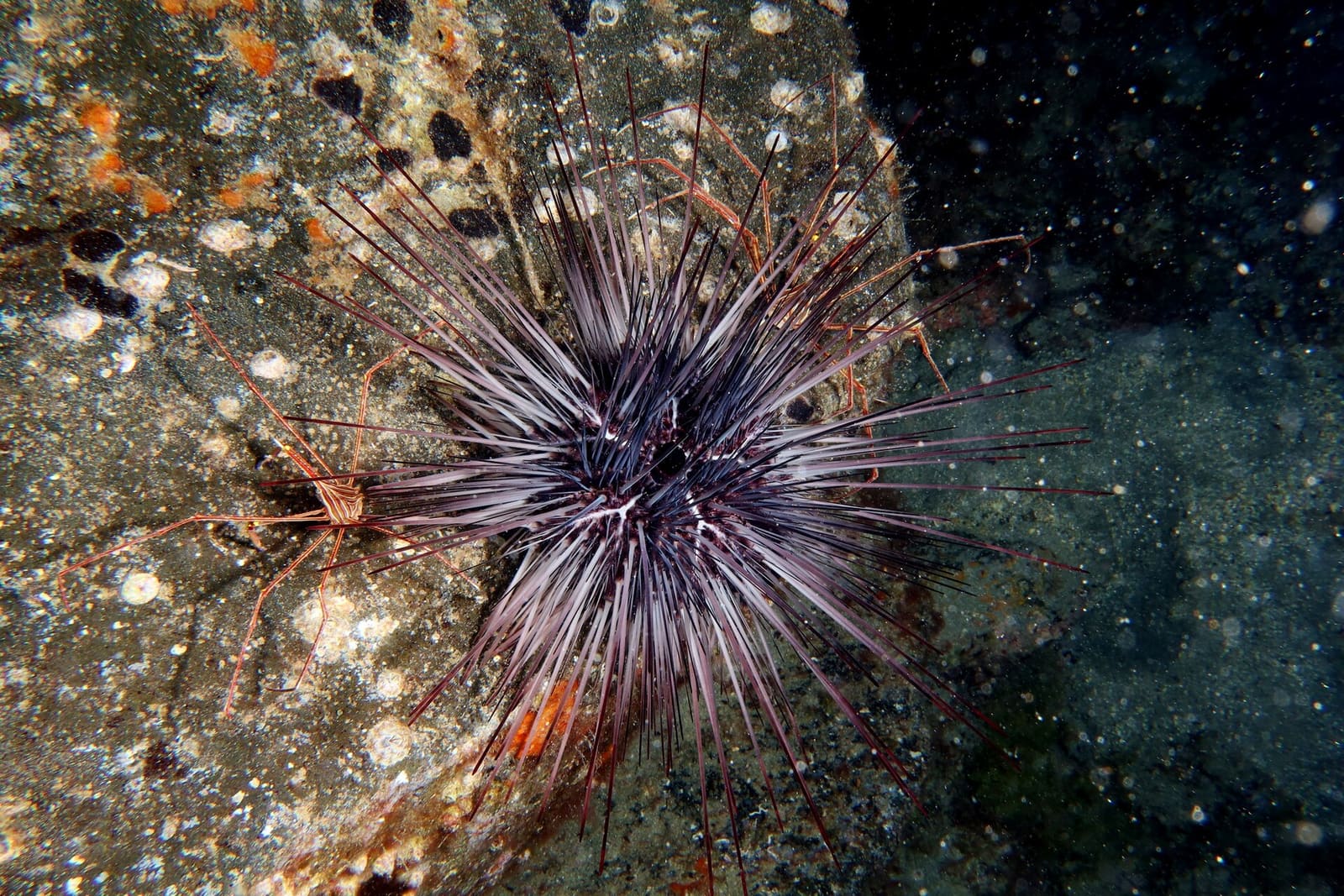
A team from the University of La Laguna has counted 58 adult long-spined sea urchins (Diadema africanum) across the whole Canary archipelago. It surveyed 12,400 m² at 76 sites with 620 transects, and according to the published information it’s the lowest figure since records began in 1965.
From plague to almost nothing
Some seabeds once held more than 14 urchins per square metre. Between August 2022 and June 2025, only 17 of the 76 surveys found any, always at fewer than 0.04 per m². Larval collectors recorded no juveniles at all.
Iván Cano Pérez’s doctoral thesis, supervised by José Carlos Hernández Pérez, describes it as an “ecological bottleneck”: too few adults and a progressive loss of genetic diversity.
How it spread
| Place | What happened |
|---|---|
| La Gomera | Origin of the die-off, in March 2022 |
| Tenerife | 99.66% drop from 2021 |
| Bocaina, La Palma and Gran Canaria | The die-off reached them too |
| El Hierro | No die-off reported |
Possible causes include westerly currents, southerly storms and an amoeba toxic to the urchin. It’s part of a pandemic in the Diadematidae family, with mortality of 90% to 99% in the Caribbean, the Mediterranean and the Red Sea.
What changes on the seabed
The long-spined urchin grazes on algae. For years it created “barrens”, bare rocky seabeds that covered more than 15 km of coastline. Without it, algae are returning. The best case would be the return of macroalgae forests; the worst, turfs of opportunistic or invasive algae. The thesis concludes that the outcome is still uncertain.
Another pressure on Canary Islands nature: the exotic species threatening the archipelago.
Sources and references
This is original editorial content based on the sources cited. Spotted a mistake? Let us know and we will fix it under our corrections policy.