The axolotl, the amphibian that never grows up and can regrow parts of its body
It lives only in the canals of Xochimilco, in Mexico City, never loses its juvenile look and can regrow legs, tail and even parts of organs. While it thrives in labs and aquariums, in the wild it is on the brink of extinction.
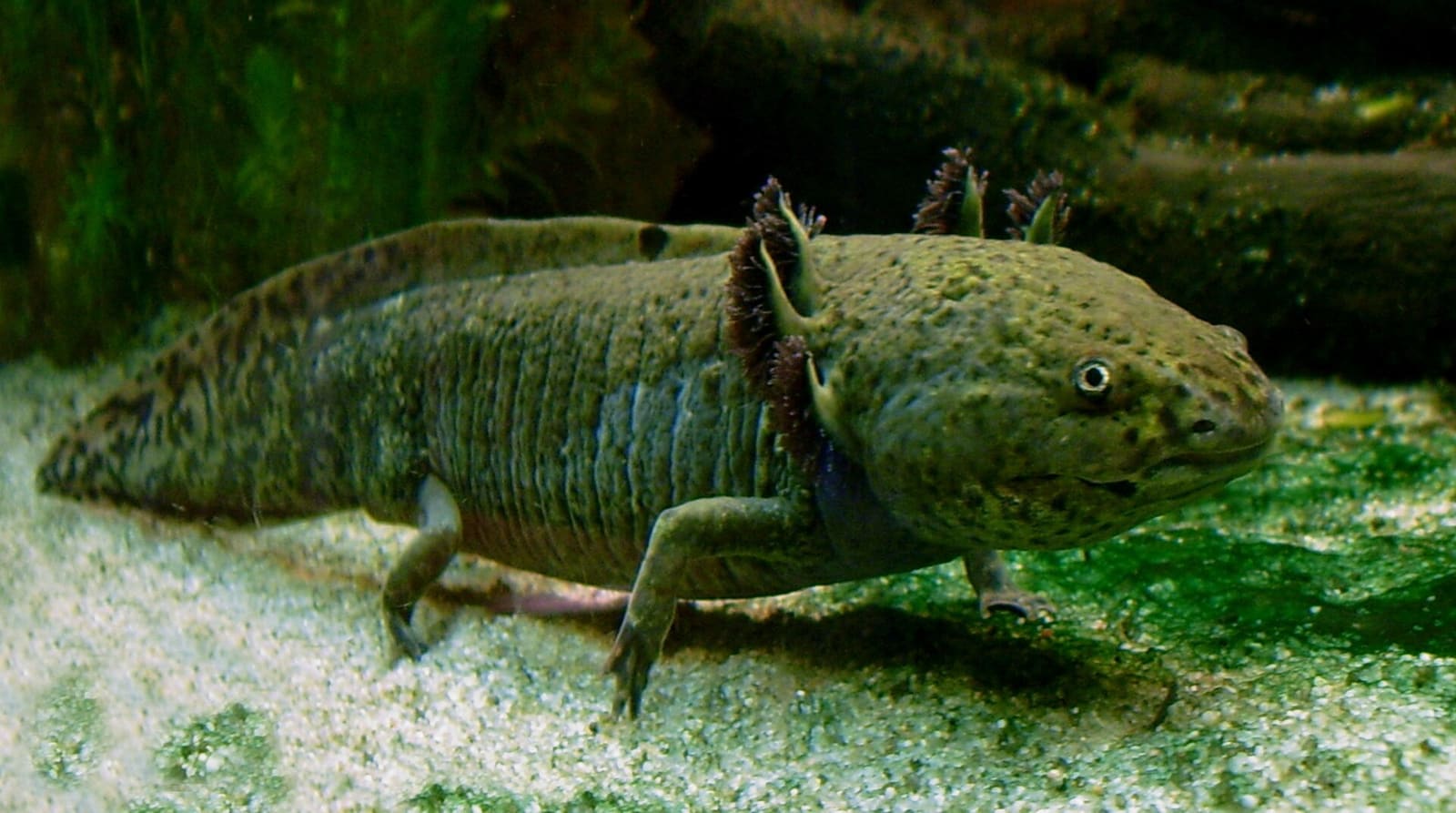
It wears a permanent smile, has gills that look like feathers and can rebuild a lost leg. The axolotl (Ambystoma mexicanum) has become a pop-culture icon, a video game character and an aquarium star. But in its only natural home —the canals of Xochimilco, in Mexico City— it is barely hanging on.
An adult in a larva’s body
Most amphibians go through metamorphosis: the tadpole loses its gills and tail and becomes a land-dwelling adult. The axolotl does not. It reaches sexual maturity and breeds while keeping its larval appearance, a phenomenon called neoteny.
That is why it keeps, for its whole life:
- External gills on both sides of its head.
- A dorsal fin running along its body.
- A fully aquatic life.
In exceptional conditions —for example, with hormone treatments in the lab— it can metamorphose, but in nature it almost never happens.
The champion of regeneration
What makes the axolotl a biology superstar is its ability to regenerate. It can rebuild:
- Entire limbs, with bones, muscles and nerves.
- Its tail, including the spinal cord.
- Parts of the heart, eyes and brain, according to several studies.
And it does so without scarring. Understanding how is one of the big goals of regenerative medicine, which is why the axolotl is one of the most studied lab animals in the world.
The conservation paradox: there are far more axolotls in labs and aquariums than in their natural habitat.
Xochimilco, a habitat in trouble
Centuries ago, the Valley of Mexico was covered by large lakes. The growing city gradually drained them. Today, wild axolotls depend on the canals of Xochimilco and the traditional chinampa system, floating gardens dating back to pre-Hispanic times.
Its threats are:
- Water pollution from sewage and agrochemicals.
- Invasive species such as carp and tilapia, which compete with it and eat its eggs.
- Habitat loss and fragmentation due to urban sprawl.
- Changes in water temperature: the axolotl needs cold water.
The IUCN lists it as Critically Endangered, the most serious category before extinction in the wild. Scientific surveys over recent decades have documented a sharp drop in its density in the canals.
What is being done
Researchers from UNAM and local organisations are working with chinamperos (chinampa farmers) to create refuges: stretches of canal with filtered water and barriers that keep invasive fish out. They also promote chinampa farming without agrochemicals and certify “axolotl-friendly” products.
If you want one as a pet
In many countries captive breeding is legal and does not directly affect wild populations, but it requires cold water, filtration and specific care. An axolotl must never be released into the wild outside its native range.
The axolotl is not the only animal with astonishing abilities: discover others in the animals that can survive conditions that would kill a human.
Sources and references
This is original editorial content based on the sources cited. Spotted a mistake? Let us know and we will fix it under our corrections policy.