Did you know that marmots spend up to six months asleep underground?
When the cold arrives, the Alpine marmot shuts itself in a burrow with its family and spends almost half the year in deep torpor. Its heart almost stops and it lives off the fat it built up in summer.
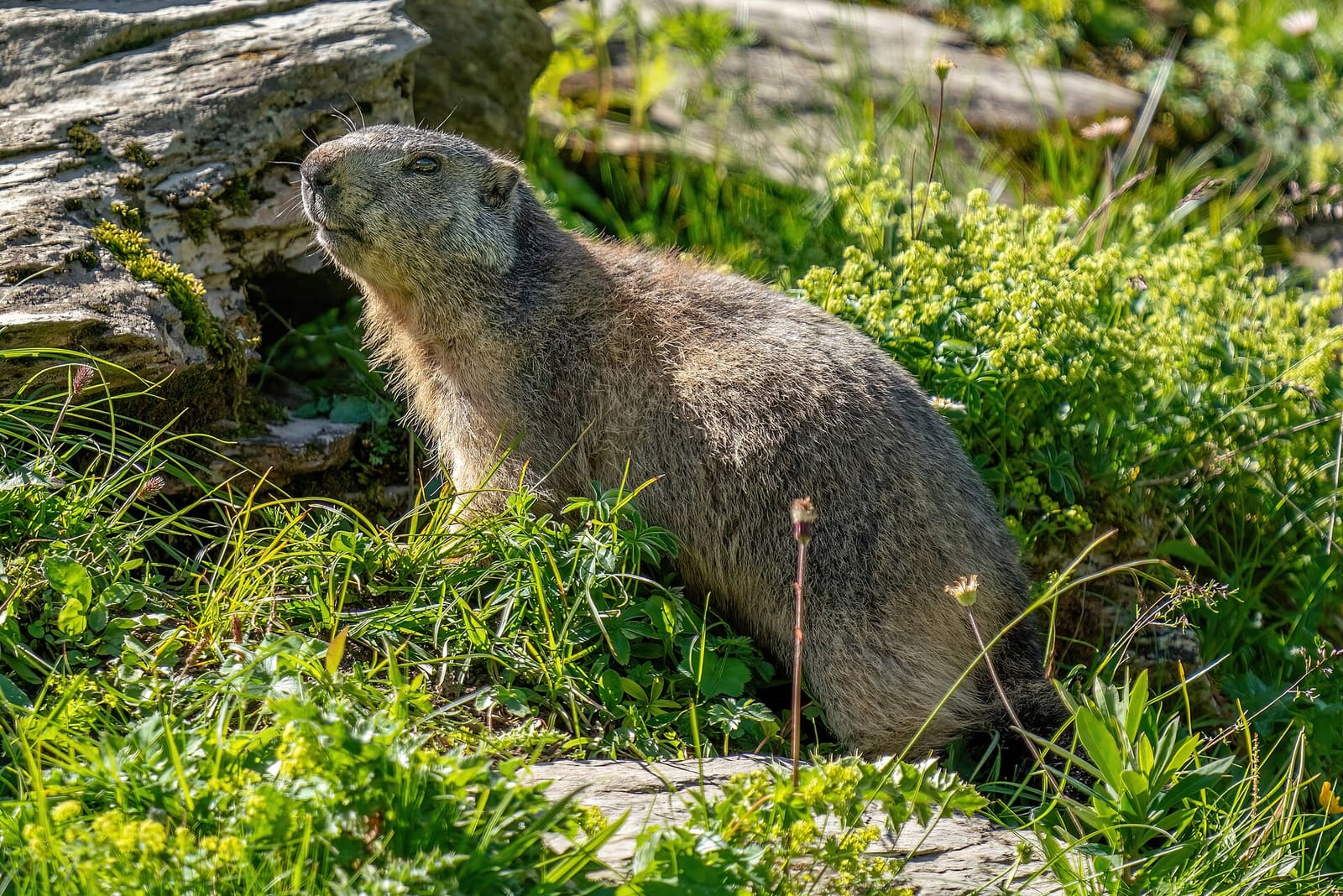
If you have walked in the Alps or the Pyrenees in summer, you have probably heard a sharp whistle among the rocks: it is a marmot warning the others that it has seen you. What you may not know is that this little animal spends almost half the year asleep.
Half a year underground
The Alpine marmot (Marmota marmota) lives in mountain meadows, usually between 1,200 and 3,000 metres. Winter there is long and there is nothing to eat, so its strategy is radical: around October it goes into a deep burrow, plugs the entrance with earth and grass, and does not come out until April.
The body in slow motion
During hibernation, its body almost shuts down:
| Active in summer | Hibernating | |
|---|---|---|
| Heartbeat | Over 100 per minute | Just a few per minute |
| Breaths | Dozens per minute | One or two per minute |
| Body temperature | ~37 °C | A few degrees above zero |
Every so often it “wakes up” for a few hours, returns to its normal temperature and cools down again. Those arousals use up a lot of energy.
All the energy for the winter comes from the fat it built up in summer. That is why you will see them eating non-stop in August and September.
Sleeping as a family
Alpine marmots hibernate in groups, sometimes more than ten animals. The adults huddle around the year’s young, which are smaller and lose heat faster. It is one of the reasons they live in family colonies.
How to watch them without disturbing them
- Look for meadows with scree in summer, early in the day.
- Stay at a distance and keep quiet; binoculars are your best friend.
- Do not feed them: they get used to people and it harms them.
In the Pyrenees they were not native in recent times: they were introduced from the Alps in the 20th century and are now common on both sides. If these survival strategies fascinate you, see the animals that survive conditions that would kill a human.
Sources and references
This is original editorial content based on the sources cited. Spotted a mistake? Let us know and we will fix it under our corrections policy.