Edelweiss, the snow flower: the science behind the symbol of the Alps
Its velvety look is not decorative: it is armour against the radiation, cold and dryness of the high mountains. The natural and cultural history of the most famous flower in the Alps.
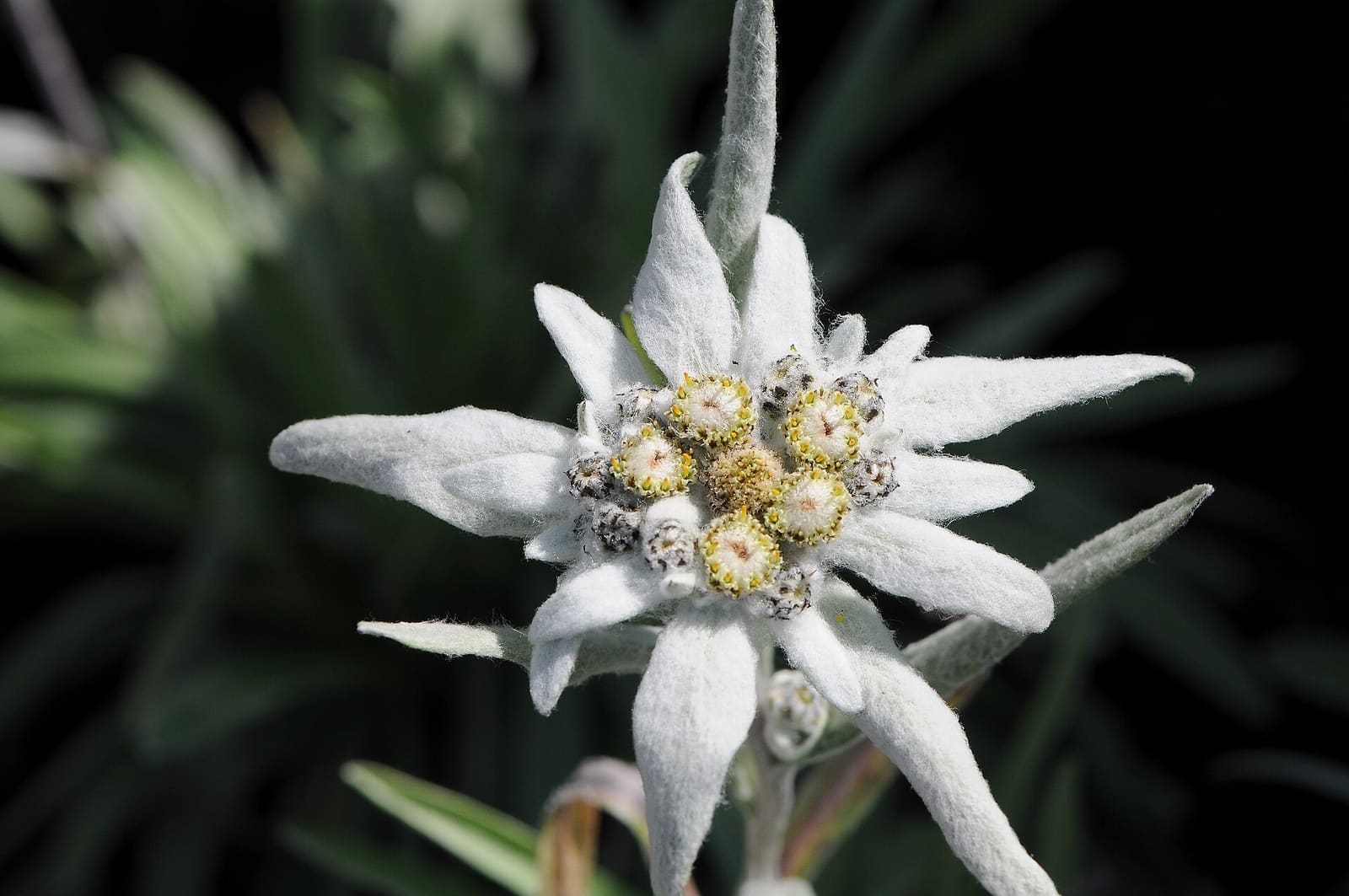
Few plants carry so much symbolism. Edelweiss appears on coats of arms, mountain troop badges, logos, banknotes and souvenirs in every Alpine village. In the 19th century it became a trophy of bravery: you had to climb to dangerous places to find it. But behind the myth lies a fascinating plant, perfectly designed to survive in one of Europe’s harshest environments.
It is not what it seems
What most people call “the flower” is actually an inflorescence. In the centre there are several yellowish flower heads, each made up of many tiny flowers. Around them opens a star of bracts —modified leaves— covered in a dense white felt. It is these bracts that give it its characteristic look.
It belongs to the daisy family (Asteraceae), the same as the daisy and the sunflower. Botanists today classify it as Leontopodium nivale subsp. alpinum, although for a long time it was known as Leontopodium alpinum. The genus name Leontopodium means “lion’s foot”, after the shape of the inflorescence.
A coat of hairs
The velvety look is not decorative. The woolly hairs covering the leaves and bracts do several jobs in the high mountains:
- Reduce water loss in a dry, windy environment.
- Insulate against the cold at night.
- Protect against ultraviolet radiation, which is very intense at altitude. Materials physics research has studied how the structure of these hairs absorbs much of the UV radiation.
Edelweiss is an example of how a plant just a few centimetres tall solves problems engineers are still studying.
Where it grows
It lives mainly between 1,800 and 3,000 metres, on stony grasslands, ridges and rock crevices, with a preference for limestone soils. It is found in the Alps, the Pyrenees, the Carpathians and other European mountains. The genus Leontopodium also has many species in the mountains of Asia, from the Himalaya to China, where it is thought to have originated.
Protected because of its popularity
Fame almost cost it dearly. In the late 19th and early 20th centuries, mass picking to sell to tourists decimated accessible populations. That is why it was one of the first plants to be protected by law in several Alpine regions. Today it is protected in many areas of the Alps, and elsewhere picking it is regulated.
If you find it on a hike:
- Do not pick it. Not one, not even “just as a keepsake”.
- Photograph it without trampling its surroundings: neighbouring plants are fragile too.
- Do not share the exact location of small populations.
Many of the edelweiss sold as garden plants come from cultivation, which reduces pressure on wild plants.
A symbol with history
In German, edel means “noble” and weiß means “white”. Its association with mountaineering, purity and courage made it the emblem of Alpine clubs and mountain military units in several countries. It is also one of the unofficial national flowers of Austria and Switzerland.
An uncertain future
Like many high-mountain plants, edelweiss faces rising temperatures, which push species from lower altitudes upwards and shrink the space available for those already living near the summits. It is a phenomenon being studied on peaks across Europe, and we explain it in the natural places that could change radically this century.
Sources and references
- Info Flora – Swiss national data centre on flora
- Anthos – Spanish plant information system
- Conservatoire et Jardin botaniques de Genève
This is original editorial content based on the sources cited. Spotted a mistake? Let us know and we will fix it under our corrections policy.